The Start of Community Governance

Evolving Vision’s tokenomics for the next phase
Over the past months, the Vision ecosystem has continued to take shape.
The wallet is live, Vision Protocol is operating, the foundation for Vision Chain has been established through our partnership with Optimism, and the first pieces of the broader infrastructure are now in place.
As the ecosystem matures, the tokenomics model needs to mature alongside it.
The Vision team, the Board of the Vision Web3 Foundation, and the Web3 Committee are proposing the first major evolution of the VSN economy: reducing emissions and beginning the transition towards a more sustainable, activity-driven model.
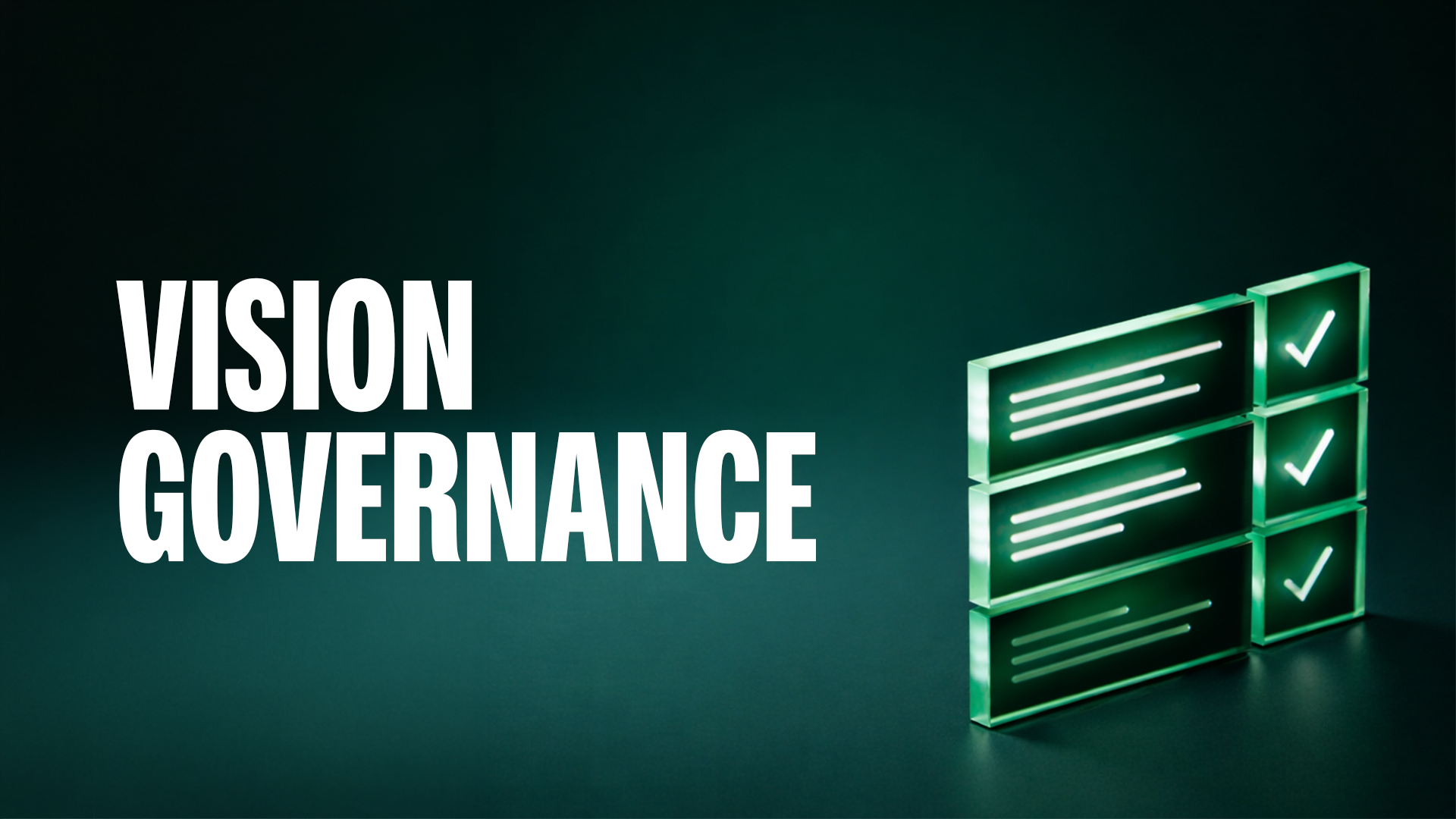
At the same time, we are introducing the first-ever VSN governance vote.
This marks the beginning of a broader shift from guided development towards shared governance.
From expansion to sustainability
When the VSN tokenomics were designed, the market environment looked very different.
The initial model focused heavily on growth and ecosystem expansion, with annual emissions set at 5%, equivalent to roughly 5 million VSN per week.
That approach made sense during the earlier phase of ecosystem bootstrapping. But as product usage and revenue generation progresses, the economic model also needs to evolve.
The long-term objective has always been clear:
Move from incentive and emission-driven growth towards usage-driven economics supported by real activity.
To support that transition, the Foundation is proposing to reduce annual emissions from 5% to approximately 2.5%, targeting an onchain staking yield of roughly 5% APY.
Over time, staking rewards are also intended to be increasingly supported through ecosystem buybacks rather than emissions. Future votes will give the community the opportunity to decide how tokens acquired from the market are used, whether for additional staking rewards, developer grants, ecosystem growth initiatives, marketing campaigns, or burns.
The path towards a more sustainable supply model
The Foundation will continue to offset new emissions by burning at least the same amount of VSN until the end of 2026. At the proposed emission rate, this translates to a minimum burn of around 30 million VSN per quarter throughout 2026, targeting a net supply inflation of zero at minimum.
Since emissions over the past months were still based on the previous 5% model, the Foundation also plans to burn additional tokens during the transition period to help offset this higher historical issuance and bring the system back to a more neutral baseline.
Beyond that, any VSN collected through product usage, fee benefits on Bitpanda, or future buybacks can also be burned, depending on community decisions through governance.
The goal is simple: reduce structural sell pressure, improve long-term supply dynamics, and gradually move towards a system where token support comes from real usage and revenue rather than emissions.
As the Vision Wallet and its products evolve, the focus shifts towards generating consistent activity and revenue across market cycles. Over time, this should enable meaningful buybacks directly tied to ecosystem usage.
Why governance starts now
Governance was always intended to become part of Vision.
Until now, however, the ecosystem was simply not mature enough for it to make practical sense.
That is beginning to change.
The first governance proposal focuses on emissions because it directly impacts the long-term structure of the ecosystem. Rather than implementing such a change unilaterally, we believe the community should participate in the decision.
This is the beginning of a shared model where holders actively help shape the economic direction of the ecosystem.
How voting will work
Governance will follow a simple principle:
1 VSN = 1 vote
Both staked and unstaked VSN will count.
Voting itself will take place transparently through Snapshot.org.
Throughout the voting period, a live dashboard will display:
- Yes / No distribution
- participation levels
- and total voting power
In the Vision Wallet
A dedicated governance section will allow users to:
- read the proposal
- review the rationale
- and vote directly onchain
On Bitpanda
Due to the structure of the Broker Wallet, voting will happen through an in-app flow inside the Vision profile section.
Votes will then be matched with user balances and submitted on Snapshot through delegated proxy wallets.
Through external wallets
Vision holders on external wallets will be able to connect directly to Snapshot via Wallet Connect.
Voting timeline
The newest Vision Wallet release which includes governance as well as partial withdrawals for staking and lending is currently being reviewed by Google and Apple.
Once this review is through, we can start the vote, which will be live for 7 days.
Exact dates, links, and voting instructions will be shared via email with Bitpanda customers, across Discord, X, Telegram, and inside the Vision Wallet and Vision profile section on Bitpanda.
The next phase
This proposal is not about short-term market reactions.
It reflects the next phase of the ecosystem: moving from setup to sustainability, from emissions-driven growth to activity-driven economics, and from guided development towards broader community participation.
FAQ:
Q: Is this purely a reaction to the market, or is there another plan behind it?
It was always planned to reduce emissions after the first year. The current market environment has led us to the decision to bring it to vote earlier. The longer-term plan is to forego emissions entirely and have staking rewards come only from product revenues.
Q: Will there be the option to suggest topics for future governance decisions?
Yes, we are working on a framework together with community representative Lukas Kurzmann under which the community can propose topics for governance decisions to the Web3 Committee.
Q: Can the change be reversed in the future?
Yes, a future vote to increase the emission rate is possible
Q: What happens if the vote does not pass?
If that is the case, the current tokenomics remain unchanged. Governance only makes sense if the outcome is respected, regardless of whether the proposal passes or fails.
Q: Could buybacks eventually become larger than the current emissions?
Potentially, yes. That is one of the long-term goals behind shifting towards revenue-supported tokenomics. If ecosystem activity grows sufficiently, buybacks could outweigh emissions over time.
Q: Why is the Foundation involving the community now?
Because the ecosystem has reached a point where community participation can become meaningful. Governance only works when there are real products, real infrastructure, and real economic decisions to make. We are entering that phase now.
The terms and conditions for the first Governance vote can be found here: https://blog.vision.now/terms-and-conditions-vip1/
Disclaimer
This crypto-asset marketing communication has not been reviewed or approved by any competent authority in any Member State of the European Union. The issuer and the offeror of the crypto-asset are responsible for the content of this crypto-asset marketing communication. Crypto-assets are volatile and carry a risk of total loss.
Vision Chain is an Ethereum Layer 2 rollup blockchain built using the Optimism OP Stack. The Vision Chain and the Vision Token (VSN) are issued by the Vision Web3 Foundation which is an independent and unregulated Swiss Foundation. Use of the Vision Chain may be subject to your local laws and regulations. Not an offer or solicitation to acquire VSN.
For full details on VSN, see the official white paper under: https://www.bitpanda.com/en/legal/vsn-white-paper